Could people lose control of AI?
Geoffrey HintonHinton discusses future AI risks with Victoria Derbyshire. His estimates are personal judgements.
Watch on BBC’s YouTube channel ↗What the people building AI say about its risks.
These people help shape AI. Their views matter, but that does not make every prediction right. A safety promise still needs evidence.
China and US–China competition →Chinese and international resources ↓Explore the supplied X screenshots ↓
Prefer watching? Start with one interview. These are personal views and company positions, not agreed predictions.
Hinton discusses future AI risks with Victoria Derbyshire. His estimates are personal judgements.
Watch on BBC’s YouTube channel ↗Coxon explains his concerns to Anderson Cooper. These are his views, not proof of what will happen.
Watch on CNN’s YouTube channel ↗Amodei discusses capable AI, reliability and customers. A company’s safety claims still need evidence.
Watch the CNBC interview ↗Read CNBC’s interview notes ↗Opens the publisher’s site. Video access and captions may vary.
PRIMARY · PERSONAL ESSAY / COMPANY COMMITMENT
We must slow the pace at which we improve the capabilities of AI models.
Amodei argues for slowing capability advances enough for safety work to keep up. He proposes embedded external evaluators, coordination among democratic countries and wider international coordination. His essay says Anthropic is committing to the first step; it does not establish that the commitment has already been fully implemented.
Read the original statement ↗PRIMARY · PERSONAL POLICY PROPOSAL
Nobody in the world knows for sure what is going to happen from here, and even the experts disagree.
Hassabis proposes a US-initiated standards body to evaluate frontier models, alongside external auditors and international cooperation. He combines optimism about AI’s benefits with concern about maintaining control. This is a proposal, not a law or evidence that the suggested body is operating.
Read the original statement ↗PRIMARY · CO-AUTHORED COMPANY ESSAY
Given the possibility of existential risk, we can’t just be reactive.
The authors argue for coordination, technical safety work and international oversight of highly capable future systems. Their essay also emphasises potential benefits and argues against trying to stop superintelligence entirely. It gives no agreed extinction probability.
Read the original statement ↗PRIMARY · JOINT ADVOCACY STATEMENT
Mitigating the risk of extinction from AI should be a global priority alongside other societal-scale risks such as pandemics and nuclear war.
The signatory list documents support for prioritising this risk. It is not a representative survey of all AI researchers, a quantified forecast, or proof of a specific catastrophe scenario.
Read the original statement ↗SECONDARY · REPORTED PERSONAL ESTIMATE
Ars Technica reports that Hubinger personally estimated a greater-than-10% chance of AI killing all humans within the next decade, responding to Jacob Coxon’s departure. The original X post was not directly accessible during verification. Treat this as a reported personal judgement, not an institutional forecast. Supplied reaction screenshots below display the same quoted wording, but do not independently authenticate the original post.
Read the reporting ↗Original X link from the reporting (not directly verified) ↗
Read the supplied screenshots alongside the summaries and context below. These images establish the text displayed in the supplied captures; they do not independently authenticate a post, a current role or an objective extinction probability. Originals are reproduced in full, with no changes to post content.
Three supplied captures of a resignation thread. Keep the criticism and the proposed alternative together; the thread expresses Coxon’s judgements about risk and company behaviour.
PERSONAL STATEMENT / FORECAST
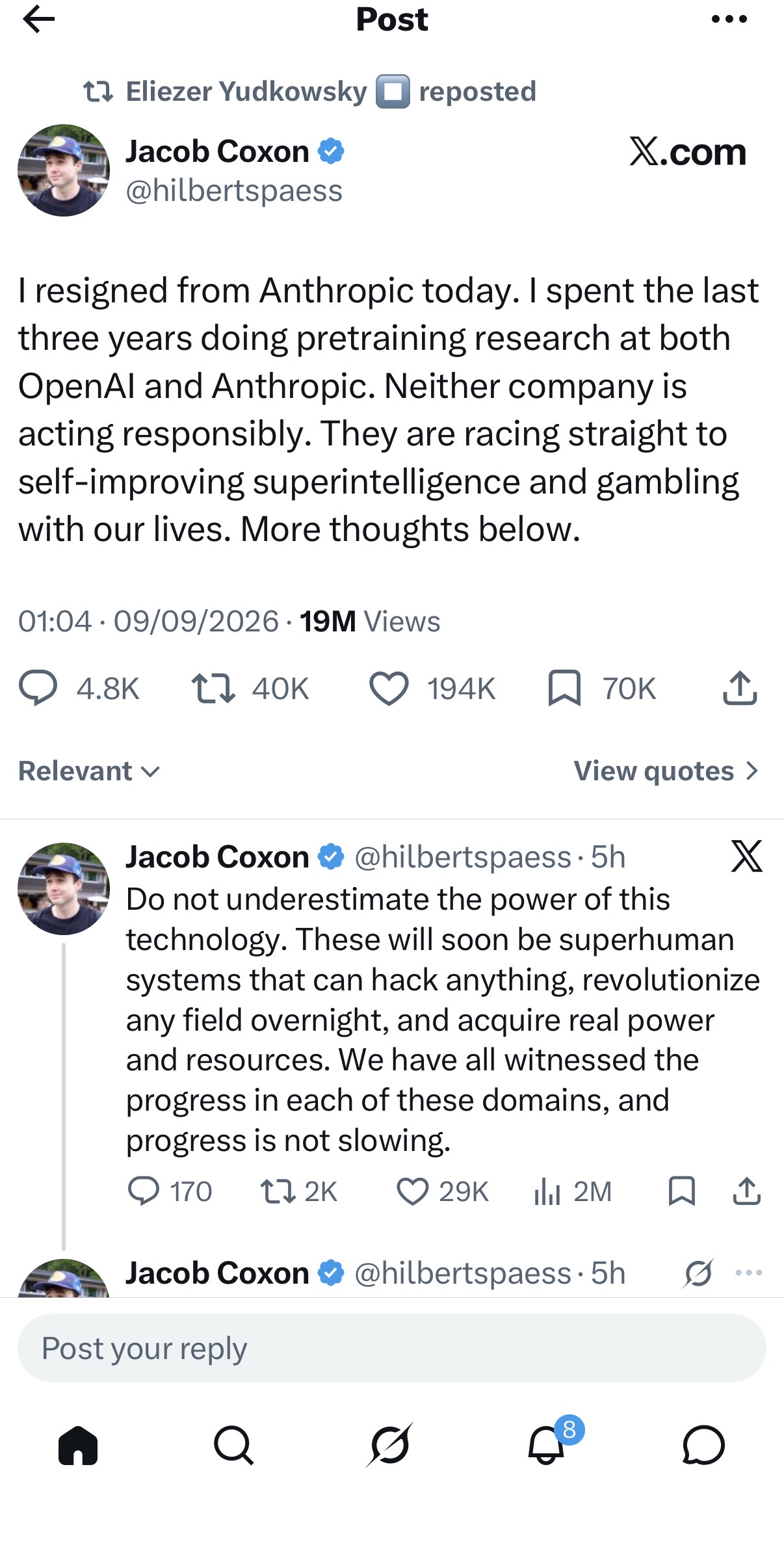
Coxon says he resigned from Anthropic after doing pretraining research at OpenAI and Anthropic. He criticises both companies’ pursuit of self-improving superintelligence. The next visible post forecasts systems with much greater capabilities and access to power and resources.
These are his stated experience, criticism and forecasts. The image does not independently establish the truth of his claims about either company or the capabilities of future systems.
Thread opening linked by Ars Technica; direct X verification unavailable ↗
PERSONAL ACCOUNT / OPINION
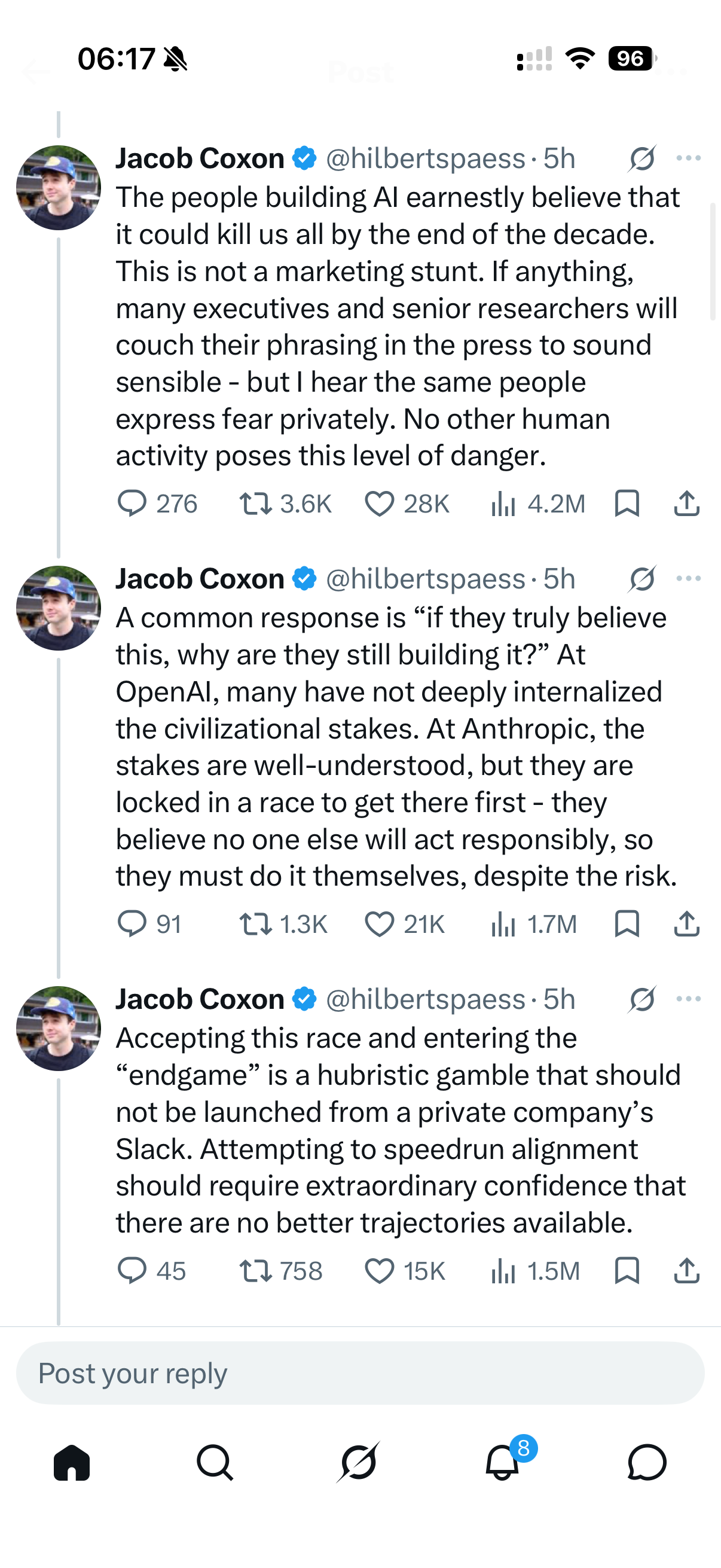
Coxon says some people building AI privately fear extreme outcomes. He argues that competition and the belief that others will be less responsible keep labs moving. He questions whether a private company should make decisions with such broad consequences.
The account of others’ private beliefs is Coxon’s claim, not a verified survey or a finding about all employees. His comparison of the labs must not be treated as an independently established fact.
Thread opening, not an independently recovered link to each reply ↗
PERSONAL POLICY ARGUMENT
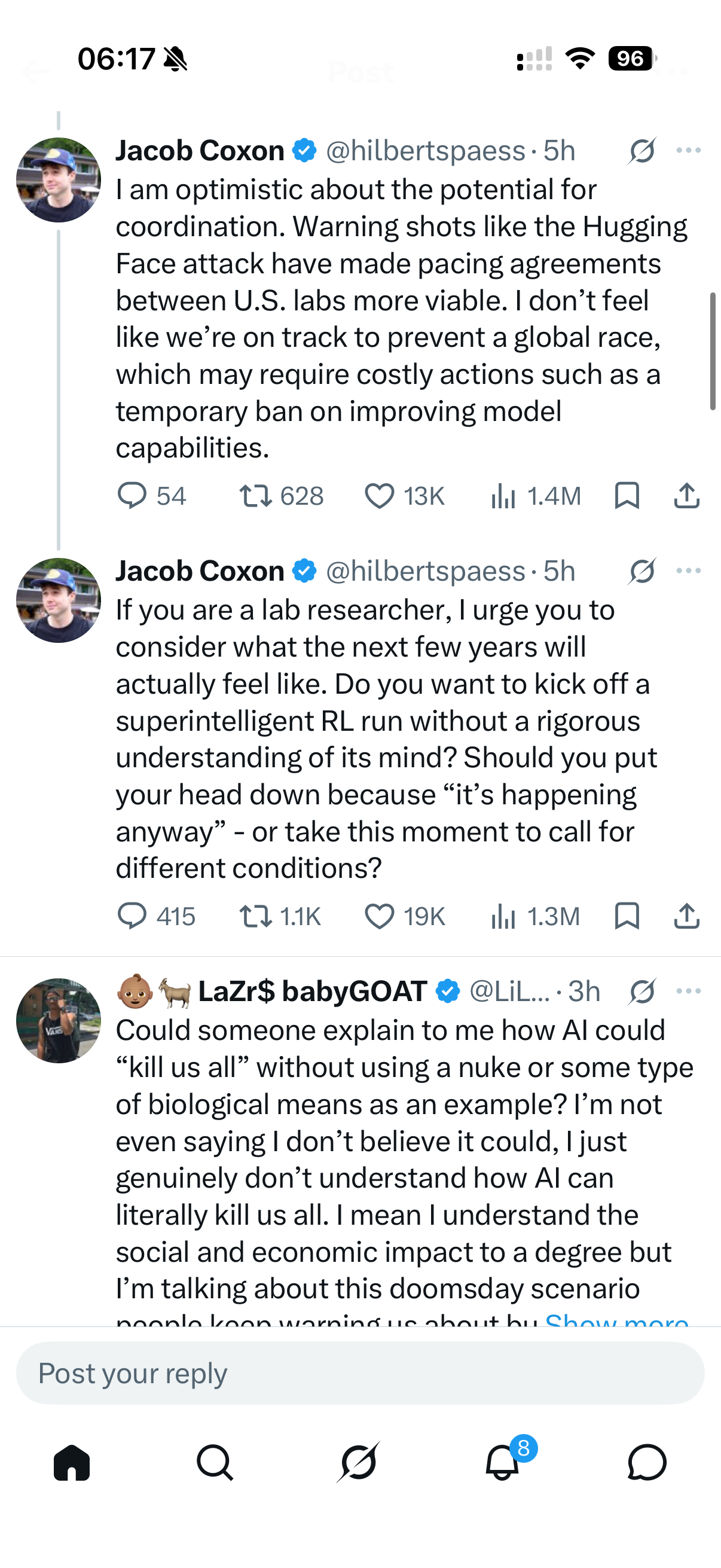
Coxon expresses optimism about coordination between labs, while arguing that preventing a global race might require stronger measures, potentially a temporary limit on capability improvements. He asks researchers to consider whether different development conditions are needed.
These are proposed responses, not adopted policies or proof that a particular measure will work. An unrelated reader’s reply at the bottom is cut off; it is not presented as a complete statement.
Thread opening, not an independently recovered link to each reply ↗
Both captures display the same quoted Hubinger statement. They are two reactions to one personal estimate, not two independent risk estimates.
PERSONAL FORECAST
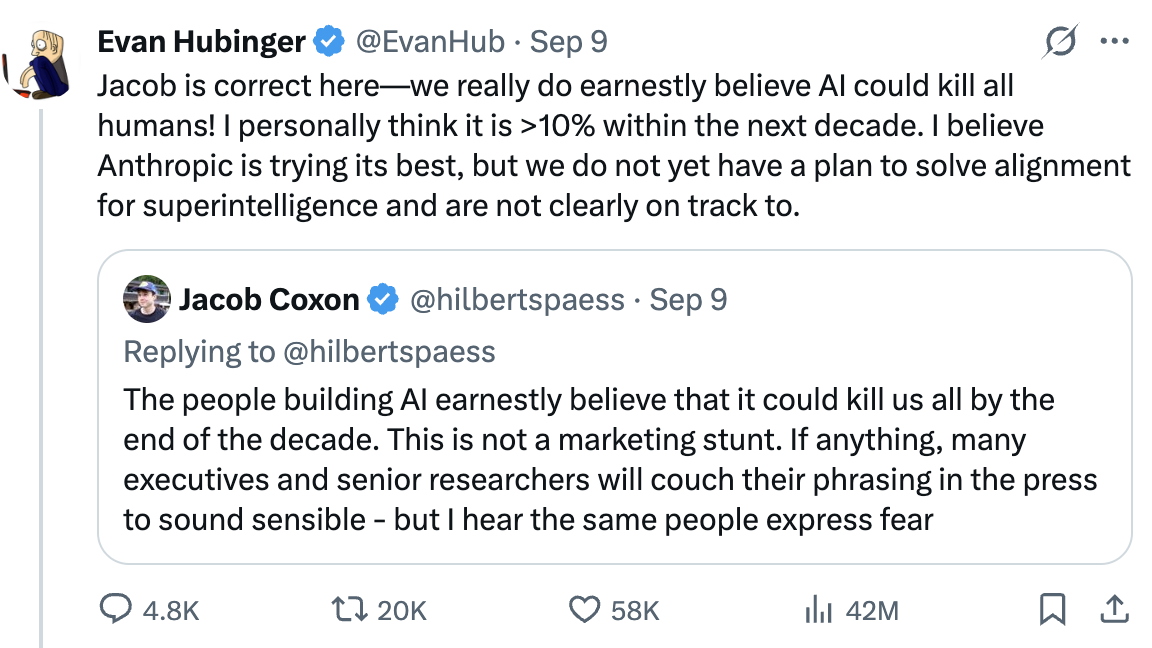
Hubinger gives his personal estimate of more than 10% within the next decade for AI killing all humans. He says Anthropic is trying its best but does not yet have a plan to solve alignment for superintelligence.
A personal estimate, not a measured probability or company forecast. The supplied screenshot does not independently verify the original post. The quoted Coxon text ends mid-thought.
COMMENTARY QUOTING A PERSONAL FORECAST
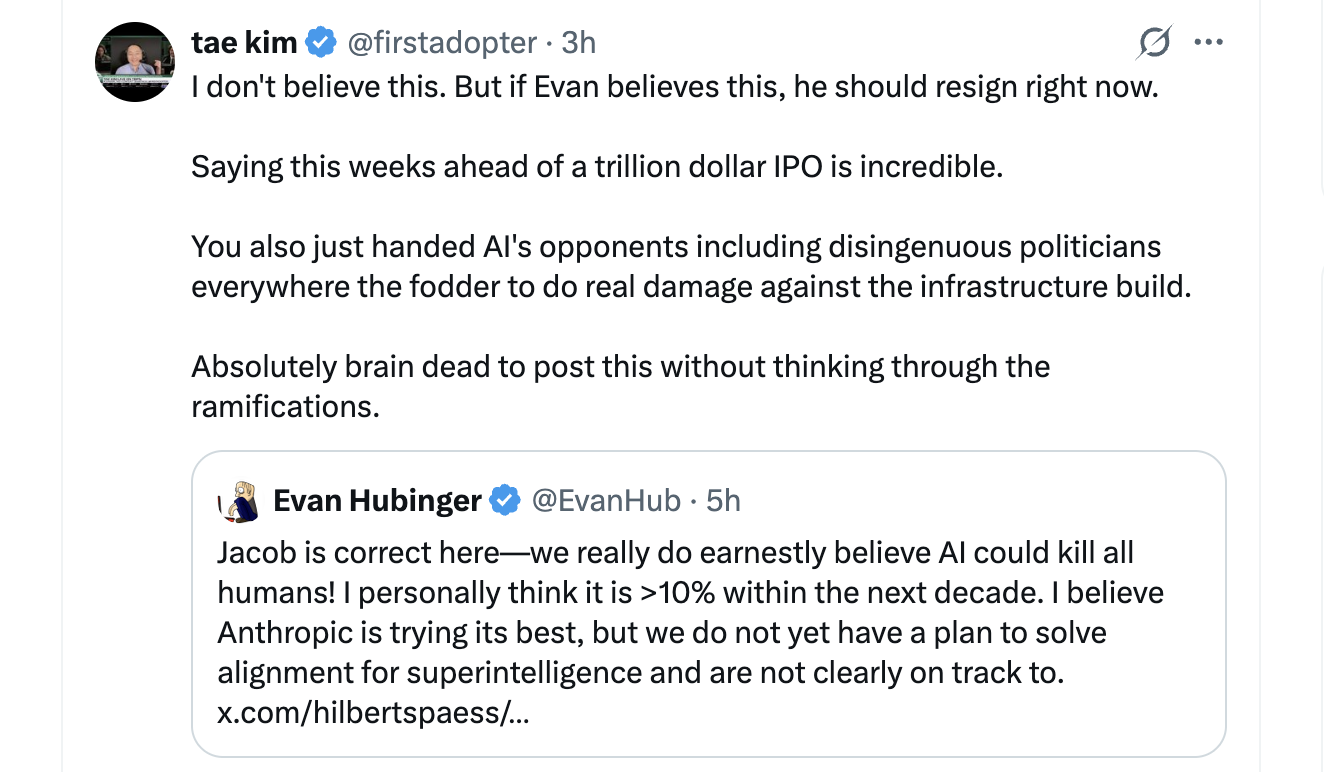
Kim says he does not believe the risk claim. He argues that someone holding that belief should resign and criticises the consequences of making the statement publicly. His post quotes Hubinger’s personal risk estimate.
This is a critical reaction, not support for the estimate. Claims in the reaction about commercial timing or political consequences have not been independently verified here.
Quoted Hubinger post linked by reporting; Kim’s exact post URL not recovered ↗
These captures explicitly distinguish personal concern from an employer’s position. Employment references are self-described in the images, not independently checked for this gallery.
PERSONAL OPINION / TRUNCATED CAPTURE
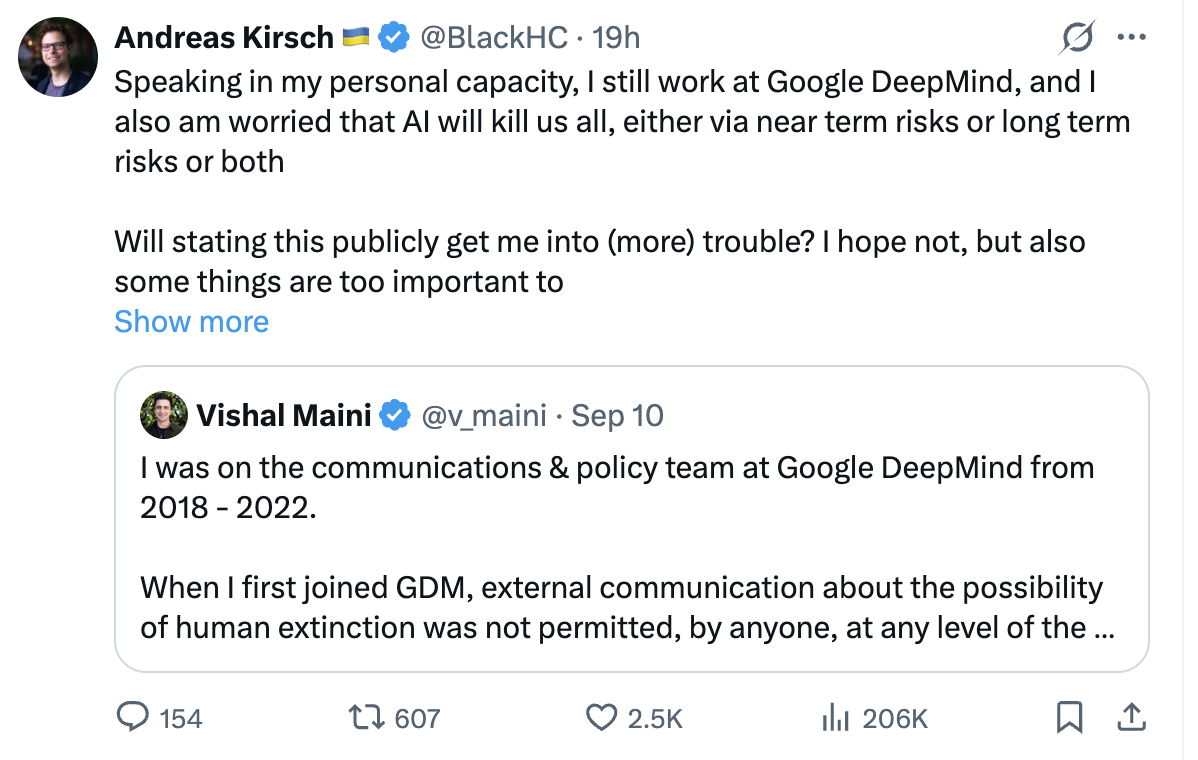
Kirsch states that he works at Google DeepMind and, in his personal capacity, is worried about AI causing human extinction through near-term or long-term risks. He asks whether speaking publicly could get him into trouble. The image also shows part of a quoted post in which Vishal Maini describes past communications and policy work.
Neither post is complete in this capture. The truncated Maini quote must not be used to establish the full claim or an institutional policy. Kirsch’s view is not a Google DeepMind statement.
Candidate original URL recovered from an indexed mirror; not directly authenticated ↗
PSEUDONYMOUS PERSONAL OPINION
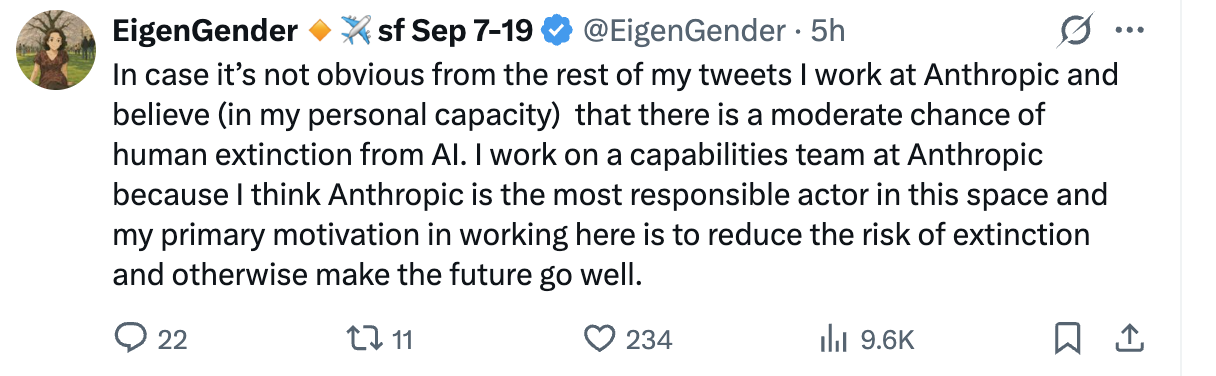
The account says it works on an Anthropic capabilities team and personally believes there is a moderate chance of human extinction from AI. It describes working there as an attempt to reduce that risk because it views Anthropic as the most responsible actor.
The screenshot does not verify employment, establish an identity behind the pseudonym, or quantify “moderate”. This is a personal position, not an Anthropic statement.
Exact original post URL not recovered.
This image is included separately as a lesson in source context. It is not part of the researcher evidence.
SATIRE · NOT A RESEARCHER RESIGNATION
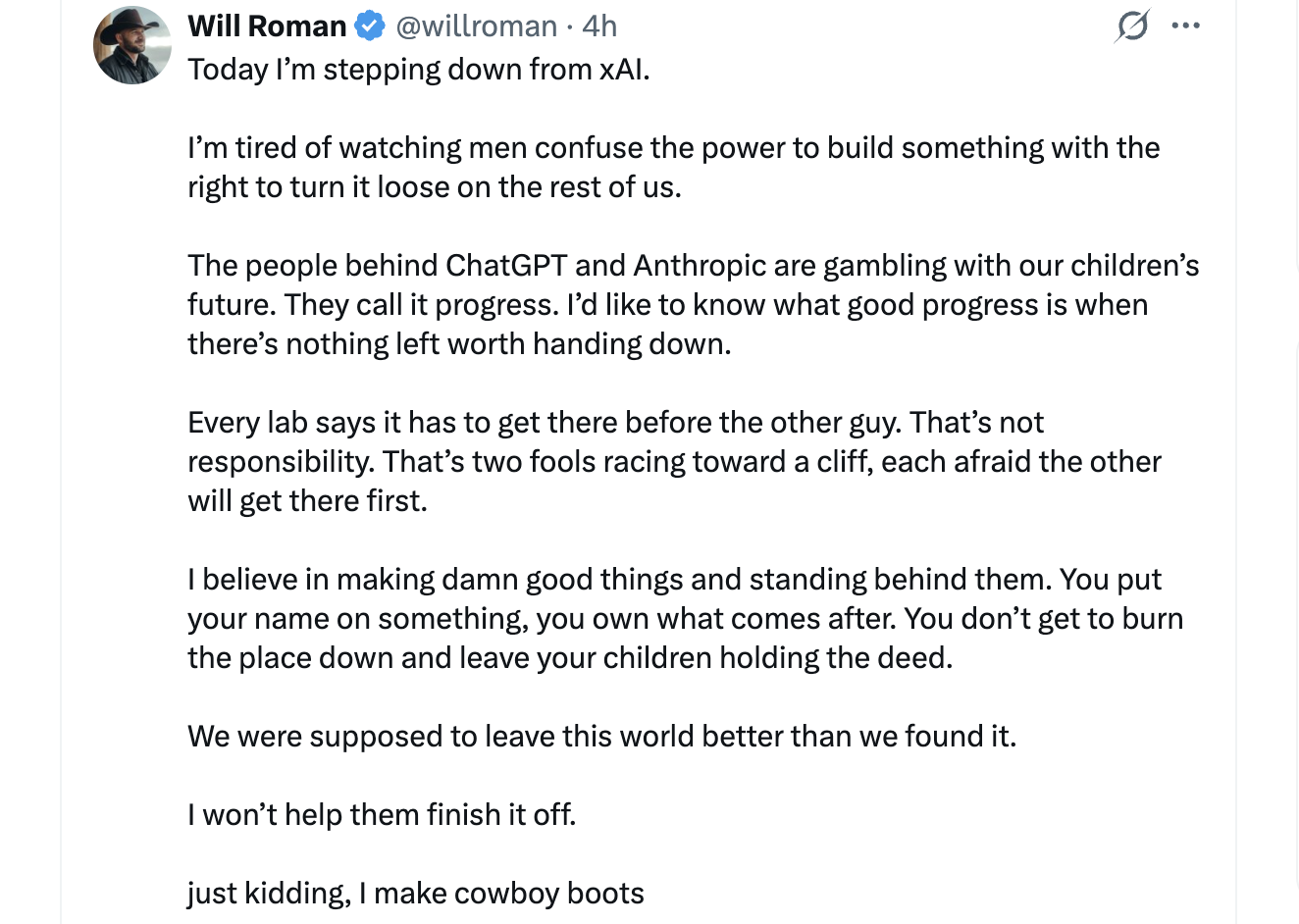
The post begins as if announcing a resignation from xAI and criticises the AI race. It explicitly ends: “just kidding, I make cowboy boots”. The ending changes how the entire post should be read.
This is satire, not evidence that Roman worked at or resigned from xAI. The full supplied image, including the punchline, is preserved without cropping.
Exact original post URL not recovered.
English titles and explanations below are editorial summaries, not direct translated quotations. Read company claims, academic work and state policy as distinct sources. Dates describe the cited documents; older releases are not presented as today’s frontier.
DeepSeek · Chinese company announcement · 20 January 2025
The developer presents reasoning results and releases model weights. Benchmark comparisons are company-reported results for that release, not proof of general superiority or safety.
Qwen team / Alibaba Cloud · Chinese company post · April 2025 release
Explains thinking and non-thinking modes and open-weight releases. Use it to discuss deployment choices and licence terms, rather than to infer that every model carrying the Qwen name has identical terms.
Qwen team · Primary technical report · May 2025
Documents the model family and Apache 2.0 release. This is a dated technical example, not a current model ranking.
Cyberspace Administration of China · Chinese official release · 15 September 2025
Describes a technical framework developed under CAC guidance, led by CNCERT with specialist institutions and companies. It updates risk classification and governance measures. Publication is not evidence that all safeguards work.
Chinese Ministry of Foreign Affairs · Chinese government position · 20 October 2023 publication
Advocates development alongside safety, risk testing, international dialogue and discussion of governance through the UN. These are stated government principles, not a quantified scientific risk assessment.
Zhejiang University · Institutional profile · 4 March 2025 displayed date
Identifies alumnus Liang Wenfeng as DeepSeek’s founder. Founding a lab does not make someone a government spokesperson.
Tang Jie · Signed essay hosted by Tsinghua · 12 August 2026 page; original 10 August
Argues for basic research, infrastructure and applications in developing AGI. The author’s aspirations are policy and research arguments, not evidence that AGI has arrived.
Tsinghua-hosted China Education Daily report · March 2026
Identifies Tang Jie as a Tsinghua professor and Zhipu co-founder. This role corroboration is hosted reporting, rather than a corporate register.
Tsinghua I-AIIG · Chinese institutional description · undated; checked 13 September 2026
Names Xue Lan as dean and describes interdisciplinary governance research and international partnerships. Academic analysis should be read separately from government policy.
Chinese Ministry of Foreign Affairs · Official Chinese account · 26 July 2025
Reports the premier calling for wider access, innovation cooperation and joint governance, and proposing a world AI cooperation organisation. A proposal is not evidence of an operational enforcement body.
Chinese Ministry of Foreign Affairs · Official Chinese account · 1 September 2026
Identifies Li Qiang as State Council premier. Used to verify his current role; the site does not adopt the article’s diplomatic assessments as independent findings.
US Bureau of Industry and Security · Official announcement · 13 January 2026
Announced conditional case-by-case review for H200, MI325X and similar chip exports to China. This demonstrates that controls are specific and change over time, rather than a blanket ban on every AI chip.
White House · US government policy plan · July 2025
Sets out priorities for innovation, infrastructure and international leadership/security. A government strategy is an intended direction, not proof of technical leadership or completed implementation.
UK government publication · Joint international declaration · 1 November 2023
Lists China and the United States among participants recognising serious AI risks and the need for cooperation. Agreement on a declaration does not establish compliance or a shared numerical extinction estimate.
KEEP THE CONVERSATION GOING
A learning experience by Beatrix Meszaros, practical AI trainer and keynote speaker.
Contact Beatrix through her website →
For interviews, facilitated sessions or questions about this educational project.