What kind of claim is this?
A definition, a documented position, a personal forecast or a hypothetical scenario?
Try this: Point to the words that tell you. Then check the original source.
100 BUTTONS / A THOUGHT EXPERIMENT
This board has ten.
A hypothetical choice. Your clicks here cause no real-world harm. Ten buttons open overlapping scenarios, not ten measured or independent extinction risks.
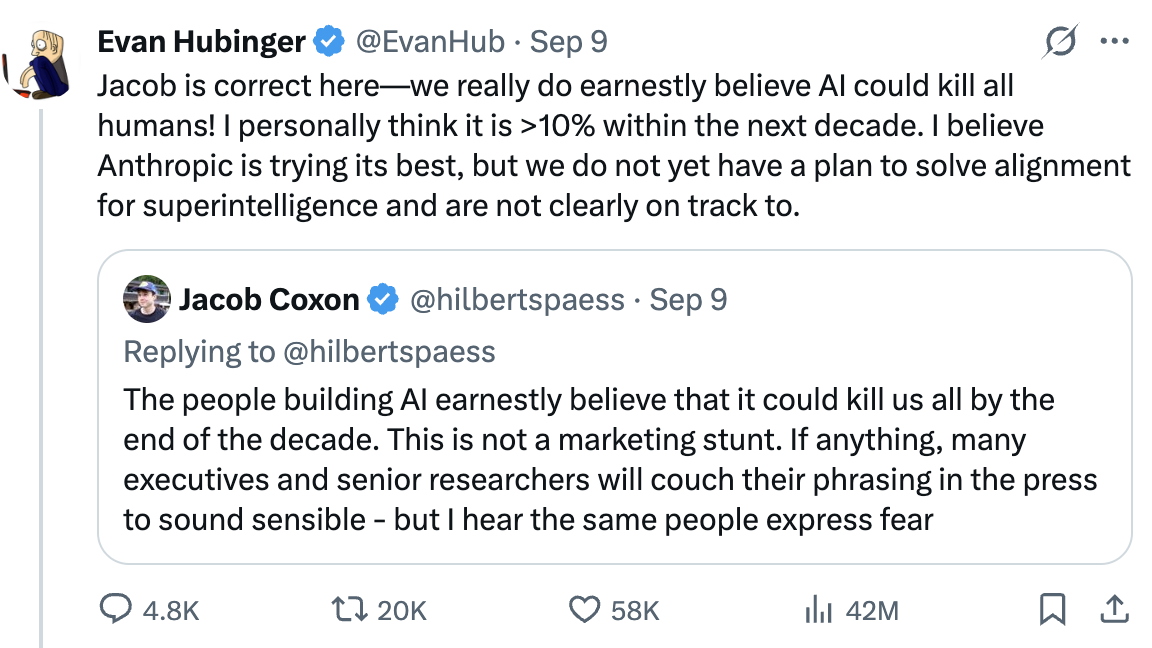
Why ten? The supplied screenshot quotes Evan Hubinger’s personal estimate of >10% within the next decade for AI killing all humans. Exactly 10/100 is our illustration, not a measured probability, consensus or Anthropic forecast. Read the context ↓
THE ESTIMATE BEHIND THE BOARD
Meet the people. Read the evidence. Ask better questions.
The real-world “buttons” are decisions about research, deployment and governance. The profiles explain documented roles and public positions, including arguments for benefits and safety. They do not accuse anyone of knowingly causing extinction.
Read leaders’ statements and safety commitments →Choose any number below. Read a short card. Answer an optional question for learning points, or keep exploring. No timer. No points for taking a risk.
Hypothetical scenarios.
The other 90 buttons revisit 40 ideas and public profiles. Numbers identify buttons; they are not clues.
Optional questions earn 10 points per new topic. You can always try again.
Pick any number. Numbers are labels, not Minesweeper clues. Ten buttons reveal hypothetical scenarios. How the board works.
The embedded Evan Hubinger post in this supplied Ryan Orhan screenshot inspired the ten danger buttons. His personal estimate is greater than 10% within the next decade for AI killing all humans.
Our board uses exactly 10 out of 100 as a simplified design choice. It is not an exact restatement of his figure, a measured probability or scientific consensus. This is not Anthropic’s official forecast.
The screenshot preserves the commentator’s reaction and embedded quote. It documents displayed wording; we could not authenticate the original X post directly.
Original post link (not directly verified) ↗
Readable excerpt from the embedded quote: “I personally think it is >10% within the next decade.” Hubinger also says he believes Anthropic is trying its best but does not yet have a plan to solve alignment for superintelligence.
Artificial superintelligence (ASI) means a hypothetical AI with abilities far beyond humans across a broad range of cognitive tasks. Today’s models are not established examples of that kind of system.
In September 2026, Ars Technica reported that Anthropic researcher Evan Hubinger personally put the chance of AI killing all humans at more than 10% within the next decade. This is one person’s judgement, not Anthropic’s official forecast. We could not directly verify the original X post; read the reporting ↗.
We selected exactly ten danger buttons as a visual reference point, not a precise reproduction of “more than 10%”. Experts disagree about the likelihood and severity of losing control of future AI. Uncertainty is a reason to examine the evidence, not proof that disaster is either inevitable or impossible.
Ten positions are randomly assigned when a board starts. Initially, a uniformly random choice has a 10-in-100 chance of revealing a scenario. As buttons open, the composition of the remaining board changes. Opening every button necessarily reveals every scenario. None of this calculates humanity’s cumulative risk.
The ten scenarios are overlapping educational sketches, not ten independent, proven extinction pathways. Some describe large-scale harm rather than extinction. The 90 other buttons revisit a library of 40 concepts and public profiles. Repetition is intentional.
EXPLORE TOGETHER
You do not need to agree. You do need to ask good questions.
5 min · Read Why ten? together. Separate hypothetical ASI from today’s models.
10–15 min · Take turns choosing. Read the source, discuss the card and try an optional question.
5 min · Choose one prompt below. Give everyone space to disagree and explain why.
A definition, a documented position, a personal forecast or a hypothetical scenario?
Try this: Point to the words that tell you. Then check the original source.
Put a possible benefit beside a possible harm. Who experiences each?
Try this: Name a safeguard and explain what it would need to demonstrate.
Who builds, funds, deploys or governs this technology? Who carries the risk?
Try this: Use your own region. What practical routes exist to question a decision?
Choose a finding that would make you more concerned, or more reassured.
Try this: Explain how you would tell a strong result from a persuasive promise.
Make it readable. Open Options & group sessions beneath the board and turn on Presenter mode for larger reveal text. The discussion cards also enlarge. Sound stays off unless you choose it; agree with the group first.
Keep it low-pressure. Questions are optional. There is no timer, speed bonus, penalty or public ranking. Points record practice answers, not qualifications or agreement with a forecast.
Start fresh for a new group. Reset board clears this browser’s points and reshuffles. Personal devices keep separate progress. Remembering points between visits is optional.
Make it local. Invite examples from the places represented in your group. Political institutions and ways to participate differ around the world.
Useful questions travel across borders. The right way to act depends on your community, institutions and circumstances.
Read the original source, date, assumptions and uncertainty. Discuss what you learn with your community, class or colleagues. A striking claim is a reason to investigate.
Read the international evidence ↗Where available and appropriate, use local consultations, representatives, regulators or professional and community organisations to ask about AI testing, oversight and routes to challenge harm. Political rights and public processes differ.
Explore UNESCO’s shared principles ↗Ask the organisations you use about safeguards and evidence. Follow independent research, share accessible learning, or contribute relevant skills to evidence-led safety work. Compare possible benefits, harms and who bears them.
Use the OECD principles as questions ↗These resources cover different places and purposes. They are not equivalent laws, universal complaint routes or proof that safeguards work. Check current local procedures before acting.
Primary research, company documents and clearly labelled reporting. Sources checked 13 September 2026. Roles and policies can change.
KEEP THE CONVERSATION GOING
A learning experience by Beatrix Meszaros, practical AI trainer and keynote speaker.
Contact Beatrix through her website →
For interviews, facilitated sessions or questions about this educational project.